When overnight temperatures in Estero fall into the mid-40s, a heat pump that cooled the house all summer can start blowing air that feels barely warmer than the room. Ice can form on the outdoor coil. Auxiliary heat strips may never come on. The outdoor fan may stall. These failures appear the first cold night of the season because heating mode uses parts that sit idle through the long Southwest Florida summer.
A heat pump does not create heat the way a furnace does. It reverses refrigerant flow, extracts heat from outdoor air, and delivers that heat indoors. When outdoor air is cool and damp, the system must also run a defrost cycle and often call on electric resistance strips to finish the job. Any weak capacitor, stuck reversing valve, failed defrost board, or burned sequencer will show itself under that load. Homeowners then ask the same questions: Why did heat stop overnight? Is this safe to wait on? Can the existing unit be repaired, or is this the year to replace it?
The rest of this page walks through those questions in the order they usually arise, then gives clear guidance on what a heating repair visit involves and what you can do before the next temperature drop.
Why Heat Fails the First Cold Night in Estero
Most homes in Estero use a heat pump with electric backup strips. In cooling season the outdoor unit rejects heat. In heating season the reversing valve changes the refrigerant path so the indoor coil becomes the condenser and the outdoor coil becomes the evaporator. That valve is a sliding piston driven by a solenoid. After years of sitting in one position through a long cooling season, the piston can stick or the solenoid coil can open. The compressor then runs, but the indoor air stays cool. That single failure accounts for a large share of no-heat calls after the first front of the year.
Defrost control is the next weak point. When the outdoor coil ices, a sensor and a control board must stop heating, reverse the system briefly, melt the ice, and return to heat. A failed sensor, a corroded board, or a stuck outdoor fan will leave the coil buried in ice. The indoor unit then cannot extract enough heat, so it either blows lukewarm air or locks out. Humidity along the Estero corridor makes icing more common than inland areas farther north. Salt air and afternoon storms also age outdoor electrical parts faster than the same equipment would age in a dry climate.
Electric heat strips themselves fail in a different way. Sequencers that stage the strips can weld shut or open permanently. High-limit switches trip and do not reset. A broken strip element will not produce heat even when the thermostat calls for emergency heat. These parts only work in heating mode, so they can sit unused from March through December and then fail the first night you need them. That is why a system that felt fine in October can leave a house cold in January.
Questions We Hear When Heat Stops Working
The first question is almost always whether it is safe to wait until morning. If the indoor unit still moves air and no burning smell is present, a short wait is usually acceptable. If you smell electrical burning, see the outdoor unit iced solid, or have no airflow at all, do not keep resetting the breaker. Repeated resets can damage the compressor or the control board. Dolphin Cooling & Heating, Inc. provides 24/7 Emergency Service for exactly these night and weekend failures, because a cold house with young children or older adults is not a problem that should wait for business hours.
The second question is whether the thermostat is the cause. A dead battery, a wrong mode setting, or a loose common wire can look like a system failure. We still treat every call as a full heating diagnosis rather than a thermostat swap. A thermostat that was replaced last year can still be correct while the reversing valve or a capacitor has failed. Guessing at the thermostat wastes time and leaves the real fault in place.
The third question is cost versus replacement. Age, refrigerant type, and how often the same unit has needed service all matter. We give a clear repair recommendation and a replacement option with a free estimate when the numbers justify looking at a new system. Financing is offered when a replacement is the better path. We do not push one answer. We show the condition of the parts we find and let you decide with the facts in front of you.
What a Heating Diagnostic Actually Includes
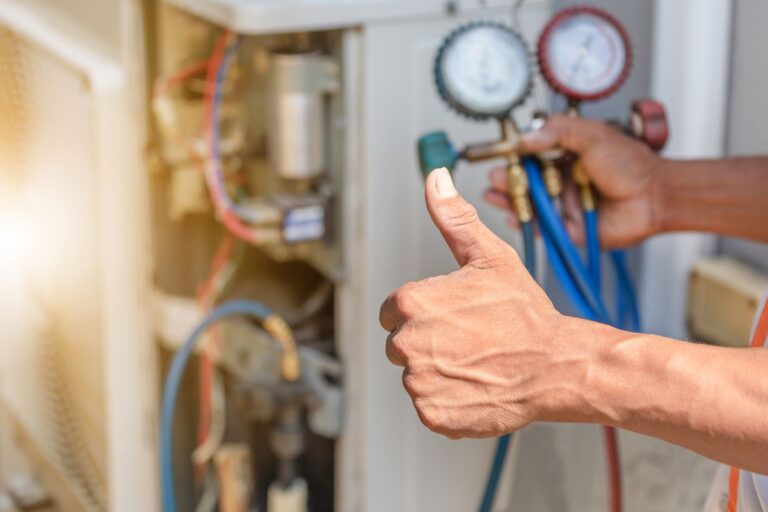
A heating repair visit starts at the thermostat and ends at the outdoor electrical components. We confirm the call for heat, the mode, and the setpoint. We check the filter and the return path because a restricted filter will ice a heat pump in heating mode just as it will freeze an evaporator in cooling mode. We measure supply and return temperatures to see whether the system is moving heat at all. A temperature rise that is too small points to refrigerant, airflow, or a failed heating element. A temperature rise that is too large points to restricted airflow or an overfiring gas furnace, if the home has one.
At the outdoor unit we test the capacitor under load, measure compressor and fan amperage, and confirm that the reversing valve shifts when energized. We inspect the defrost sensor and the control board for corrosion and correct timing. We check contactors for pitted points that drop voltage to the compressor. On systems with electric heat we open the air handler, test each strip for continuity and amperage, and verify that sequencers and limits operate in the correct order. On gas furnaces we check ignition, flame sense, inducer operation, and heat exchanger condition. These steps are the same whether the equipment is a Trane, a Carrier, or another brand. We service and replace all brands.
Refrigerant charge is checked when symptoms point to a leak or a restriction. A heat pump that is low on charge will cool poorly in summer and heat even worse in winter, because heating mode needs a full charge to absorb heat from already-cool outdoor air. We do not add refrigerant as a first guess. We confirm the need with pressure, superheat or subcooling, and temperature measurements, then repair the leak path when one is found. That sequence keeps the repair from becoming a monthly recharge.
Heating Repairs We Perform Most Often
The parts that fail in Estero heating systems are predictable. Capacitors dry out in the heat and then cannot start the compressor or the outdoor fan when heating load is high. Contactors pit and chatter. Reversing valves stick. Defrost boards corrode. Heat strip sequencers fail. Blower motors that ran fine in cooling can overheat when the system stays in heat for hours. Each of these has a clear test and a clear replacement path. We carry common capacitors, contactors, and sequencers so many repairs finish on the first visit.
Some repairs take more time. A reversing valve replacement requires recovering refrigerant, brazing, evacuating, and recharging to specification. A defrost board may need a matching sensor and a check of the outdoor fan circuit. A failed heat exchanger on a gas furnace is not a patch job. We explain the work, the time, and the reason before we start. If the unit is old and the same repair has appeared before, we put the replacement option on the table with a free estimate so you are not deciding under pressure at night.
- Capacitor and contactor replacement – these two electrical parts cause a large share of no-heat and no-cool calls and can often be replaced the same day.
- Reversing valve and defrost control – these heating-only components fail after sitting unused through summer and require a full refrigerant procedure when the valve itself is replaced.
- Heat strip and sequencer repair – electric backup heat that never comes on leaves the house cold even when the heat pump is trying to run.
- Blower motor and control board service – weak airflow or a board that will not take a heat call will stop warm air at the registers no matter what the outdoor unit is doing.
We work with Trane and Carrier equipment every week, and we also repair every other major brand found in residential systems across Marco Island, Naples, Bonita Springs, Ave Maria, Estero, Fort Myers, Golden Gate, Lely, Vineyards, North Naples, Orange Tree, and Pine Ridge, FL. Matching the correct part, the correct charge, and the correct control settings is what makes the heat stay on after we leave. A temporary workaround that gets the house warm for one night is not the standard we use.
Repair Versus Replacement for Estero Heating Systems
Repair is the right choice when the unit is relatively young, the refrigerant is still supported, and the failed part is isolated. A capacitor, a contactor, a sequencer, or a defrost board on a system that otherwise tests well is a repair we recommend without hesitation. Replacement becomes the better path when the compressor is failing, the heat exchanger is cracked, the coil is leaking in multiple places, or the same system has needed major work more than once in a short span. Age alone is not the only factor, but a heat pump that is well past its expected service life will keep producing new faults.
Efficiency also matters in heating mode. An older heat pump with a tired compressor and a marginal charge will run long cycles, lean on expensive electric strips, and still leave rooms uneven. A newer system with a correctly sized indoor coil and a working defrost cycle will heat with less strip time and lower winter electric use. We explain that difference with the readings we take on site, not with a generic sales script. When replacement is on the table, the estimate is free and financing is available so the decision can be made on the numbers rather than on a single repair invoice.
Dolphin Cooling & Heating, Inc. has focused on residential repair, maintenance, and replacement in this region since 1998. That history means we have seen the same Estero floor plans, the same attic installations, and the same coastal wear patterns for more than two decades. We use that experience to tell you whether a repair will last the season or whether the next cold front will bring a different failed part. Southwest Florida’s trusted AC experts since 1998 is not a slogan we put only on cooling work. Heating service is part of the same residential practice.
Steps That Reduce the Chance of a No-Heat Night
A heating system that is cleaned and tested in the fall fails less often in January. The outdoor coil should be clear of grass, leaves, and irrigation overspray so airflow and defrost can work. The indoor filter should be changed on a regular schedule because a dirty filter ices the outdoor coil in heat just as it freezes the indoor coil in cool. Thermostat batteries should be fresh. The outdoor disconnect and the air-handler door switch should be fully seated. These checks take little time and they remove the simple causes before a cold night arrives.
If the system has not had a professional heating check, schedule one before the first front. We test the reversing valve, the defrost cycle, the heat strips, and the electrical parts that only work in heat. Finding a weak capacitor or a corroded sequencer in November is far better than finding it at 2 a.m. in January. Maintenance does not make every part last forever, but it finds the parts that are already on the edge.
- Clear the outdoor unit – keep vegetation, debris, and sprinkler spray off the coil so defrost and airflow can work when temperatures drop.
- Change the filter on schedule – a restricted filter is one of the fastest ways to ice a heat pump in heating mode.
- Test heat before you need it – switch the thermostat to heat on a cool evening in late fall and confirm that warm air arrives at the registers.
- Call when behavior changes – short cycling, lukewarm air, or a unit that runs without heating are early signs, not problems to ignore until the house is cold.
When heat does fail after hours, 24/7 Emergency Service is available. We treat a no-heat call in Estero with the same urgency as a no-cool call in August, because comfort and safety do not follow a weekday schedule. Dolphin Cooling & Heating, Inc. will diagnose the fault, explain the options, and restore heat with a repair that matches the equipment you have. If the system is at the end of its service life, you will leave the visit with a clear free estimate and financing information rather than a guess. That is the practical path from a cold house to a working heating system.