Outdoor condenser coils in Vineyards face a cooling season that often starts in late April and continues well into November. Ambient temperatures above 90 degrees combine with dew points near 70, so a residential split system must reject heat and remove moisture for 10 to 14 hours on many days. When capacity falls, indoor temperatures climb in the afternoon even while the thermostat still calls for cooling. Supply air feels lukewarm. Rooms farthest from the air handler stay sticky. That pattern is a mechanical problem, not a setting on the wall control, and it is the most common reason Vineyards homeowners request AC repair.
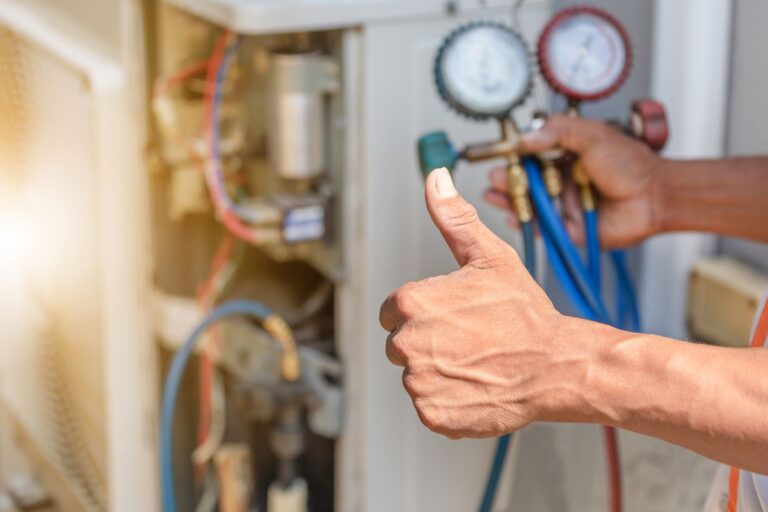
Dolphin Cooling & Heating, Inc. treats that loss of capacity as a measurable condition. We record suction and discharge pressures, superheat, subcooling, and temperature split across the evaporator. Those readings tell us whether the circuit is undercharged, restricted, or simply unable to transfer heat because the coil surface is fouled. The Vineyards climate makes those measurements more important than they would be in a short cooling season. A system that is only 10 percent off specification can still keep a home comfortable in May. The same system fails to hold setpoint in August.
A System That Runs Constantly but Never Reaches Setpoint
A compressor that never shuts off is working against a heat load it can no longer match. In Vineyards, that load includes solar gain through large window walls, heat stored in tile and stucco, and a high latent load from outdoor air infiltration. We start by confirming that the outdoor unit is actually moving the refrigerant mass flow the manufacturer specified. Low suction pressure with high superheat usually points to a refrigerant undercharge or a restriction at the metering device. High suction pressure with a low temperature split across the coil often means the indoor coil is dirty or the blower is not delivering the design airflow.
We also inspect the outdoor coil for debris, salt film, and bent fins. Vineyards sits inland from the Gulf, but afternoon storms drive moisture and organic debris onto the condenser. A coil that looks only slightly dull can still lose a large share of its heat-transfer area. We clean that surface with the correct method for the fin material, then retest. If pressures return to specification and the temperature split recovers, the repair is complete. If they do not, we move to leak detection. We use electronic detectors and, when needed, ultraviolet dye to find slow leaks at service valves, coil hairpins, and flare connections. We do not add refrigerant to a leaking circuit and leave. We locate the leak, repair it, evacuate the system to a deep vacuum, and recharge by weight to the nameplate charge.
That sequence matters because an undercharged system in this climate will freeze the evaporator on milder nights and then flood liquid back to the compressor when the coil thaws. Repeated freeze and thaw cycles damage the compressor windings and the crankcase. Catching the leak early keeps a repairable unit from becoming a replacement. Dolphin Cooling & Heating, Inc. services and replaces all brands, and we work extensively with Trane and Carrier equipment that is common in Vineyards residences. We apply the same charge and leak protocol regardless of brand.
A Sudden Shutdown After a Storm or Power Surge
Afternoon thunderstorms are frequent across Southwest Florida. A voltage spike or a brief outage can open a contactor, blow a fuse in the control circuit, or damage a run capacitor. The outdoor fan may stop while the compressor tries to start, or the entire condensing unit may sit silent while the indoor blower continues to circulate warm air. Homeowners often assume the system has failed completely. In many cases the failure is a single electrical component that we can replace the same day.
We test capacitors with a meter that reads microfarads, not just a visual check for a bulged case. A capacitor can test within a few percent of its rating and still fail under load once the outdoor temperature climbs. We check contactors for pitted faces and for voltage drop across the contacts under load. We inspect the control board for burned traces and for error codes stored in memory. On communicating systems from Trane and Carrier, we pull the diagnostic history so we can see whether the shutdown is a first event or the latest in a series of brownout trips.
Power quality in a community with irrigation pumps, golf-course equipment, and dense residential load can be uneven during storms. We look at the incoming voltage at the disconnect and at the unit lugs. If we find evidence of repeated surge damage, we discuss protection options as part of the repair, not as a separate sales visit. When the repair is complete, we run the system through a full cooling cycle and confirm that the compressor amperage stays inside the manufacturer range. Dolphin Cooling & Heating, Inc. has provided this kind of residential electrical diagnosis since 1998, and we keep the common capacitors, contactors, and fan motors for major brands on the truck so a Vineyards shutdown does not wait on a parts run.
Persistent Humidity When the Thermostat Reads Cool
A Vineyards home can feel damp even when the thermostat displays 75 degrees. That condition is a latent-load problem. The evaporator is not staying cold long enough, or the blower is moving too much air across a coil that never reaches dew point. Oversized equipment, an incorrect blower speed, a failing TXV, or a drain that is backing water into the pan can all produce the same indoor result. Occupants notice musty odor, condensation on supply registers, and swelling in wood floors or cabinetry.
We measure supply-air temperature, return-air wet bulb, and the temperature of the suction line at the evaporator outlet. Those numbers tell us whether the coil is actually condensing moisture. If the coil is warm, we look at refrigerant charge and metering. If the coil is cold but the home is still humid, we look at runtime, blower speed, and outdoor-air infiltration. A system that short-cycles because it is too large for the envelope will cool the dry-bulb temperature quickly and then shut off before it has removed enough water from the air. In that case a repair to the refrigerant circuit will not fix the comfort complaint. We explain that finding clearly and outline the mechanical options that actually address latent capacity.
Clogged condensate drains are a frequent companion problem. Algae and dust collect in the trap and the PVC run, especially when the system sits idle in winter. Water then overflows the auxiliary pan or trips the float switch and shuts the system down. We clear the drain, treat the line, and confirm that the float switch resets and that water flows freely to the exterior. Indoor humidity control is part of AC repair in this climate, not an accessory conversation. Southwest Florida’s Trusted AC Experts Since 1998 is a description we earned by treating moisture as a primary load, not a side effect.
Intermittent Cooling in a Larger Vineyards Residence
Many Vineyards homes use two or more split systems, or a single system with zone dampers. Intermittent cooling in one wing of the house while another wing stays comfortable usually points to a damper motor, a zone board, a failing blower, or a refrigerant circuit that is losing charge slowly enough that only the longest duct runs show the deficit. We isolate each circuit and each zone before we open a refrigerant line. Swapping parts across zones without measurements wastes time and does not locate the fault.
On zoned systems we verify that each damper reaches its commanded position and that the static pressure in the trunk does not rise above the blower’s design limit when zones close. High static pressure reduces airflow across the coil, which can freeze the coil and then cause water to dump into the closet when the ice melts. On dual-system homes we compare runtime and temperature split between the two units. A large difference often means one condenser is dirty, one capacitor is weak, or one circuit has a leak. We repair the failing unit first. We do not recommend replacing both systems unless both are at the end of service life and the homeowner has asked for a full replacement plan.
Dolphin Cooling & Heating, Inc. focuses on residential repair, maintenance, and replacement. When a Vineyards home needs a new air handler or condenser, we provide a free estimate and we offer financing so the decision is not forced by a single failed part. We still prefer to repair when the remaining equipment life and the nature of the fault support it. That preference is how we deliver the best possible service to current customers and to the next household that calls.
Deciding How Long to Keep Repairing an Older Condenser
Not every failure is a reason to replace the outdoor unit. A 12-year-old condenser with a failed fan motor and a clean coil is a repair. A 15-year-old condenser with a leaking coil, a compressor that is drawing locked-rotor amps, and a history of repeated charge additions is a candidate for replacement. We put those facts in front of you with the readings attached. We do not hide a repairable fault behind a replacement quote, and we do not keep adding refrigerant to a coil that will leak again in a month.
Age alone is not the deciding factor in Vineyards. Runtime hours, maintenance history, and the availability of refrigerant for that particular chassis all matter. We service R-410A and older R-22 systems, and we explain the practical limits of each. If a repair will restore reliable cooling through the current season and the next, we say so. If the same repair is likely to be followed by a compressor failure, we say that as well and we price a replacement path with a free estimate. Financing is available when replacement is the sound choice. We install and service Trane and Carrier equipment and we work on every other major brand that is already in the home.
The repair-or-replace conversation is also the right time to look at the matching indoor coil and the air handler. A new condenser on an old, restricted indoor coil will not deliver the rated efficiency or the rated latent capacity. We inspect both sides of the system before we recommend either a repair or a changeout. That inspection is part of the diagnostic visit, not a later upsell. Homeowners in Vineyards and across Marco Island, Naples, Bonita Springs, Ave Maria, Estero, Fort Myers, Golden Gate, Lely, Vineyards, North Naples, Orange Tree, and Pine Ridge, FL get the same measured approach.
What We Do When the Call Comes After Dark
Cooling failures do not wait for weekday mornings. A capacitor that has been weakening for weeks often opens after dinner, when the house has been closed and the heat load is still high. Dolphin Cooling & Heating, Inc. provides 24/7 Emergency Service for residential systems. We treat an after-hours call as a live comfort and safety issue, especially when indoor temperatures climb in a home with young children, older adults, or occupants with respiratory conditions.
On an emergency visit we stabilize the home first. That may mean a temporary capacitor, a reset of a tripped float switch, or a safe bypass of a failed control so air moves again while the correct part is sourced. We then complete the permanent repair as soon as the component is in hand. We do not leave a system in an unsafe state. We check electrical connections, confirm that the condensate path is open, and verify that the compressor is not short-cycling before we leave the property.
Emergency work follows the same diagnostic standard as a scheduled visit. We still measure pressures and electrical values. We still identify the root cause rather than swapping the first part that looks worn. That discipline is how a Naples air conditioning service company stays useful after midnight and not only during posted hours. If the fault is simple, we finish it on the spot. If the fault requires a compressor or a coil, we explain the next step, provide a free estimate, and schedule the follow-up without delay.
The process we use on every Vineyards AC repair call is consistent, whether the visit is at 2 p.m. or 2 a.m.:
- Interview and visual survey – We ask when the problem started, what the system did just before it failed, and whether any recent storms, filter changes, or thermostat adjustments occurred. We then inspect the indoor and outdoor units for ice, water, burned insulation, and obvious mechanical damage.
- Electrical and control tests – We measure incoming voltage, capacitor microfarads, contactor condition, and motor amperage. On communicating equipment we read stored fault codes before we clear them.
- Airflow and coil inspection – We check filter condition, blower wheel cleanliness, coil face loading, and static pressure when the symptoms point to airflow. A restricted return can mimic a refrigerant problem and we will not open the circuit until airflow is confirmed.
- Refrigerant circuit measurements – We record saturated temperatures, superheat, subcooling, and temperature split. Those values decide whether we search for a leak, a metering fault, or a compressor that is no longer pumping.
- Repair, verify, and document – We complete the repair, run a full cooling cycle, and confirm that the system holds setpoint and that condensate is leaving the drain. We explain what failed and what we did so you can decide on maintenance or future replacement with facts in hand.
Vineyards homes ask a lot of an air conditioner. Long runtimes, high moisture, and afternoon electrical disturbances all shorten the life of capacitors, contactors, and coils. AC repair done with measurements, not guesswork, restores capacity and prevents the next failure from arriving in the middle of the next heat wave. Dolphin Cooling & Heating, Inc. brings that method to every residential call in Vineyards and throughout Marco Island, Naples, Bonita Springs, Ave Maria, Estero, Fort Myers, Golden Gate, Lely, Vineyards, North Naples, Orange Tree, and Pine Ridge, FL. When your system runs without reaching setpoint, shuts down after a storm, or leaves the air cool but damp, we diagnose the circuit, repair the fault, and leave the equipment operating inside its design range.