A heating system that fails on a cold night in Ave Maria is not a minor inconvenience. Indoor air that drops into the low sixties disrupts sleep, increases health risk for older adults and young children, and forces you to rely on space heaters that raise energy use and fire risk. Most homes here run in cooling mode for the large majority of the year. Heating parts sit unused for months. Corrosion, seized valves, weak capacitors, and cracked igniters do not show themselves until the first real cold front arrives. That delay is why heating repair in Ave Maria matters in practical terms. You need a correct diagnosis the first time, not a guess that leaves you without heat overnight.
At Dolphin Cooling & Heating, Inc. we treat heating repair as a core residential service, not a side task. We have focused on home repair, maintenance, and replacement since 1998. We service and replace all brands and work regularly with Trane and Carrier equipment. When heat stops, you need a team that understands how Florida heat pumps and furnaces actually fail after long idle periods. We provide that work with free estimates and financing when a larger repair or replacement is the right path.
Idle Months Create the Failures You Notice Overnight
Heat pumps do most of the heating work in Ave Maria. A heat pump moves heat from outdoor air into the home by reversing refrigerant flow. The reversing valve, the defrost control board, the outdoor sensors, and the auxiliary electric heat strips all sit idle through the long cooling season. Moisture, insects, and voltage spikes still act on those parts. When the thermostat finally calls for heat, a stuck reversing valve will send the system into cooling mode instead. A failed defrost board will let ice build on the outdoor coil until the unit shuts down on a safety. Auxiliary heat strips that have corroded terminals will not energize, so the home never reaches the set point even though the compressor is running.
Gas furnaces, where they are installed, face a different set of idle-season problems. The hot surface igniter becomes brittle. The flame sensor coats with oxide. The inducer motor bearings dry out. The first call for heat can produce a lockout, a repeated click with no ignition, or a short cycle that never delivers useful warmth. Dual-fuel systems add another layer. The control board must decide when to switch from the heat pump to the furnace. A failed outdoor temperature sensor or a miswired control will keep the system on the wrong heat source and drive up operating cost while the home stays cold.
Airflow problems hide during cooling season and appear the moment heat is required. A dirty filter, a closed supply register, or a restricted return will cause a heat pump to ice the indoor coil or a furnace to overheat and trip the limit switch. You may hear the blower run and feel little or no warm air at the vents. That pattern is common after months of cooling-only use. We look at airflow first because a restriction will make every other repair fail again within days.
Questions That Come Up Before We Arrive
The first question is almost always whether the thermostat is the only problem. A dead battery, a wrong mode setting, or a loose common wire can stop a call for heat. We still treat that as a full heating complaint. A thermostat that looks correct on the wall can send a weak signal, lose communication with a communicating control board, or display a set point that the equipment never reaches. We verify thermostat output with a meter before we open the air handler or furnace. That step prevents unnecessary part replacement and keeps the visit focused.
The second question is whether a repair is worth doing or whether the system is at the end of its life. Age alone does not answer that. A ten-year-old heat pump with a failed capacitor and a dirty coil is a repair. A twenty-year-old furnace with a cracked heat exchanger is a replacement for safety. We explain the condition of the heat exchanger, the compressor, the coil, and the control board in plain language. We give a free estimate for the repair and, when it applies, a free estimate for replacement so you can compare both paths. Financing is available when the better path is a new system.
The third question is safety. A burning smell, a gas odor, soot around a furnace cabinet, or a carbon monoxide alarm requires immediate action. Do not keep resetting the equipment. Shut the system off at the thermostat and at the breaker or gas valve if you can do so safely. We offer 24/7 Emergency Service for heating failures that leave a home unsafe or without heat when temperatures drop. Call and we will treat the visit as an emergency, not a next-day appointment.
What a Thorough Heating Diagnosis Involves
We start with the complaint and the sequence of events. Did the system run and then stop? Did it never start? Is there ice on the outdoor unit? Is there a code on the control board? Those details point us to the circuit we test first. We inspect the filter, the drain, the outdoor coil, and the electrical connections before we replace any part. A loose lug on a contactor or a swollen capacitor will produce the same no-heat symptom as a failed compressor. Replacing the expensive part first wastes money and leaves the root cause in place.
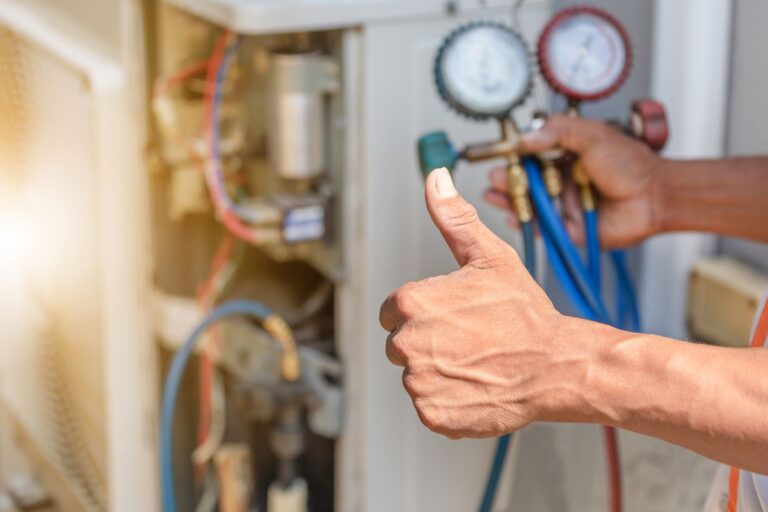
Electrical tests come next. We measure incoming voltage, capacitor microfarads, amp draw on the compressor and blower, and continuity on heat strips and igniters. On a heat pump we confirm that the reversing valve shifts and that the defrost cycle initiates and terminates on the correct sensors. On a gas furnace we check inducer draft, ignition sequence, flame signal in microamps, and temperature rise across the heat exchanger. Temperature rise that is too high points to airflow. Temperature rise that is too low points to undersized burners or a heat exchanger problem. We record those readings so the repair is based on numbers, not on a single symptom.
Refrigerant and airflow complete the picture on heat pump systems. Low charge will let the unit run without delivering useful heat and will often cause the outdoor coil to ice even when defrost is working. We weigh in or recover and recharge to the manufacturer specification when a leak is found and repaired. We do not add refrigerant as a shortcut. Restricted ducts or a blower wheel packed with dust will produce the same low leaving-air temperature. We measure static pressure and leaving-air temperature so we know whether the repair belongs in the refrigerant circuit or in the air path. That distinction is the difference between a lasting repair and a callback.
- Reversing valve and defrost faults – A valve that does not shift or a board that never starts defrost will leave the home cold and the outdoor coil blocked with ice. We test valve coils, sensors, and board outputs before we condemn the valve itself.
- Ignition and flame sensing problems – A cracked igniter or a dirty flame sensor will lock out a furnace after a few attempts. We replace the failed part and confirm a stable flame signal so the unit does not lock out again the next night.
- Capacitors, contactors, and heat strips – Weak start components and burned heat-strip relays are common after long idle periods. We measure capacitance and inspect contacts under load rather than judging parts by appearance alone.
- Airflow and safety-switch trips – Dirty filters, closed registers, and failed limit switches cause short cycles that feel like a complete heating failure. We restore airflow and test every safety in the sequence before we close the cabinet.
Making the Repair Last Through the Next Cold Front
A completed repair is not the end of the visit. We run the system through a full heat cycle and, on heat pumps, through a defrost cycle when conditions allow. We confirm that supply air temperature rises as specified, that the outdoor unit is clear of ice, and that the thermostat maintains the set point without short cycling. We show you the filter location, the breaker, and the outdoor disconnect so you can perform the simple checks that prevent a second emergency. If the system is a heat pump, we explain how auxiliary heat should operate and what it means if the emergency heat light stays on.
Maintenance after a repair reduces the chance that idle-season damage repeats. A heating check before the first cold front finds weak capacitors, dirty flame sensors, and restricted coils while you still have time to schedule the work. We perform that maintenance as part of our residential service offering. Homes across Marco Island, Naples, Bonita Springs, Ave Maria, Estero, Fort Myers, Golden Gate, Lely, Vineyards, North Naples, Orange Tree, and Pine Ridge, FL see the same pattern: cooling equipment runs hard all summer, heating parts sit unused, and the first cold night reveals the neglect. Regular service on both modes keeps the same equipment reliable in January and in August.
When a repair is not the responsible choice, we say so. A cracked heat exchanger, a compressor that is shorted to ground, or a coil that cannot hold a charge after multiple leak repairs is a replacement conversation. We service all brands and we install Trane and Carrier systems when a new unit is the better path. Free estimates cover both the repair you asked for and the replacement we recommend if that is the safer option. Financing helps you move forward without delay when the home cannot wait for another winter. Dolphin Cooling & Heating, Inc. is here for that decision with the same direct approach we use on every heating repair call in Ave Maria.
Southwest Florida’s heating season is short, but the systems that serve it still fail in predictable ways. You do not need to wait until the house is uncomfortable to ask for help. If the heat is weak, noisy, or completely out, contact Dolphin Cooling & Heating, Inc.. We diagnose first, explain the findings, and restore heat with parts and methods that match the equipment in your home. 24/7 Emergency Service is available when the failure happens after hours and the temperature is still falling.